

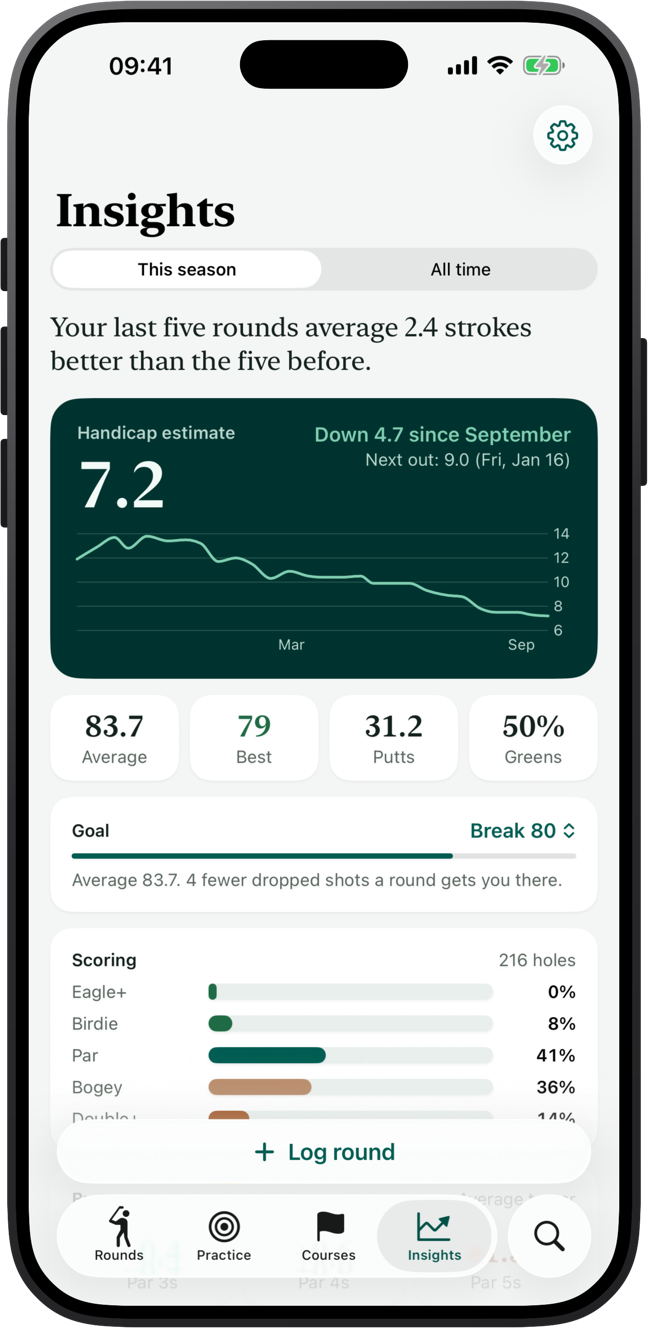
How a handicap is worked out
The World Handicap System, used by golf's national federations since 2020, works in three steps. Each round becomes a score differential, your best differentials become a Handicap Index, and the index becomes a course handicap for the tees you're playing.
1. Score differential
A score differential says how well you played compared with the difficulty of the course that day:
Score differential = (adjusted gross score − course rating − PCC) × 113 ÷ slope rating
- Adjusted gross score is your score with each hole capped at net double bogey: par, plus two, plus any strokes you receive on that hole.
- Course rating is what a scratch golfer is expected to score from those tees, such as 71.5.
- Slope rating is how much harder the course plays for a bogey golfer, from 55 to 155. 113 is standard.
- PCC, the playing conditions calculation, adjusts for unusually hard or easy days. It's worked out by your federation from everyone's scores, so it's usually 0 here.
For example, 84 on a course rated 71.5 with a slope of 126 is (84 − 71.5) × 113 ÷ 126 = 11.2.
2. Handicap index
Your Handicap Index is the average of your lowest 8 score differentials from your most recent 20 rounds, rounded to one decimal place. Until you have 20 rounds, fewer are used:
| Rounds | Differentials used | Adjustment |
|---|---|---|
| 3 | Lowest 1 | −2.0 |
| 4 | Lowest 1 | −1.0 |
| 5 | Lowest 1 | 0 |
| 6 | Average of lowest 2 | −1.0 |
| 7 or 8 | Average of lowest 2 | 0 |
| 9 to 11 | Average of lowest 3 | 0 |
| 12 to 14 | Average of lowest 4 | 0 |
| 15 or 16 | Average of lowest 5 | 0 |
| 17 or 18 | Average of lowest 6 | 0 |
| 19 | Average of lowest 7 | 0 |
| 20 | Average of lowest 8 | 0 |
Nine-hole rounds count too. Since 2024, a nine-hole score is turned into an 18-hole differential by adding the score you'd be expected to make on the other nine, based on your index at the time.
3. Course handicap
Course handicap = Handicap Index × slope ÷ 113 + (course rating − par)
It's rounded to the nearest whole number, and it's the number of strokes you receive on that course from those tees. Competitions often use a percentage of it, called the playing handicap: 95% in individual stroke play, for example.
What an official index adds
An official Handicap Index from your club or federation includes a few safeguards this calculator leaves out:
- Soft and hard caps slow down how fast an index can rise: once it's more than 3.0 above your lowest index of the past year, only half of any further rise counts, and it can never be more than 5.0 above that lowest index.
- Exceptional score reduction takes 1.0 off your index for a differential 7.0 or more below it, or 2.0 for 10.0 or more.
- Net double bogey is applied on every hole, and PCC for the day's conditions.
That's why the result here, and in Golf Journal, is an estimate. It's usually close, and it's useful for following your own game between official updates.
